Demumu Went Viral in China. Here's Why 40 Million Americans Need the Same Thing.
And why the US version is better.
In January 2026, an app called Sile Me — which translates, bluntly, as "Are You Dead?" — became the most downloaded paid app in China's App Store. It did exactly one thing: offered a large button you could press each day to confirm you were alive. Miss two days, and it emailed your emergency contact.
It sounds morbid. It went viral anyway.
Millions of people downloaded it within days. Not because Chinese people are preoccupied with death — but because an enormous and quietly growing population of people who live alone finally saw a tool that acknowledged a very simple, very human anxiety: if something happened to me, who would know? And how long would it take?
The answer, for most people who live alone, is uncomfortable. Hours. Maybe days.
Sile Me — also known as Demumu — gave that anxiety a one-tap solution. And the world took notice.
The Numbers Behind the Viral Moment
Demumu didn't go viral by accident. It surfaced at the exact intersection of two massive demographic trends that have been quietly building for years.
In China: Research suggests there could be as many as 200 million one-person households by 2030. That's not a niche market. That's a nation of solo dwellers — younger people choosing independence, an aging population outliving partners, a cultural shift away from multigenerational households that defined Chinese life for centuries.
In the United States: The picture is nearly identical. Data from the Census Bureau's Current Population Survey for 2025 shows that the number of one-person households in the US is approaching a record 40 million — representing 29% of all American households, an all-time high. That's roughly 1 in 3 homes with a single occupant. And that number grew by an estimated 1.3 million in 2025 alone.
As The Economist noted in late 2025, the share of people living alone has increased in 26 out of 30 wealthy nations since 2010. Marriage rates are falling. People are living longer. Younger generations are choosing independence earlier and more deliberately. The solo household is not a phase. It's a permanent, growing feature of modern life.
The Demumu moment didn't create this reality. It just finally named it.
Why Americans Watched China and Recognized Themselves
When Western media covered the Demumu story in January 2026, the framing was almost universally the same: look at this quirky Chinese app. But the comment sections told a different story. Americans weren't laughing at the concept. They were asking where to find it.
Because the anxiety is universal. The 68-year-old woman in Phoenix who lives alone since her husband passed. The 34-year-old remote worker in Vermont whose nearest neighbor is a mile away. The 22-year-old college student in a studio apartment three states from her parents. The 51-year-old divorced man who realizes, with a jolt, that no one would notice if he didn't show up to anything for three days.
These are not people who are fragile or frightened. Most of them love their independence. Most of them would bristle at being called vulnerable. But they share one quiet, practical concern: the gap between when something goes wrong and when someone finds out.
That gap, for people who live alone, can be terrifyingly wide.
What Demumu Got Right — and What It Missed
Demumu's genius was its radical simplicity. No features. No tracking. No subscriptions. No wearables. Just a button and a consequence: tap it and you're fine. Don't tap it for two days and someone who cares about you finds out.
That simplicity is exactly why it spread. It required no explanation. It asked for almost nothing. And it delivered something that no amount of complexity can buy: the feeling that someone would notice.
But Demumu was built for China, with Chinese infrastructure, sold for $1.15, and designed around email alerts rather than SMS. For most Americans, email is where urgent things go to be ignored. Text messages are where real emergencies live.
More critically, Demumu has no answer for the other half of the problem. The slow emergency — the 48-hour silence — is covered. But what about the fast one? What about right now, when you've fallen and you need someone to know immediately, not after two days of silence?
Demumu has no emergency button. You tap your daily check-in or you don't. There's nothing in between.
I'm Alive Today: The American Answer
I'm Alive Today was built in the United States, for Americans, with the lessons of Demumu and the realities of American daily life in mind.
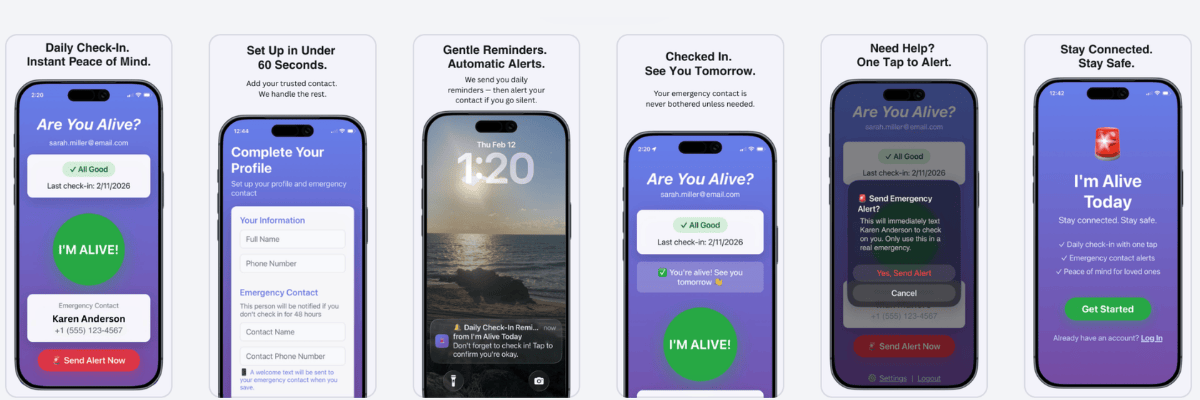
The core concept is identical: one tap a day to confirm you're okay. Miss 48 hours, your emergency contact gets an SMS — a real text message, not an email. No wearable. No hardware. No complicated setup. You're up and running in under a minute.
But where Demumu stops, I'm Alive Today keeps going.
SMS instead of email. When your emergency contact gets an alert, it arrives as a text message. In the United States, 98% of text messages are read within 3 minutes. Email open rates average around 20%. The choice matters.
The Emergency Alert button. This is the feature Demumu doesn't have and no other US check-in app has built the way we have. If something happens right now — not in 48 hours, right now — one tap sends an immediate SMS to your emergency contact. No countdown. No confirmation window to fight through. Instant.
A humane reminder system. Most check-in apps are built around anxiety. Miss your exact scheduled window? Alert goes out. I'm Alive Today works differently: you have 24 hours to check in, anytime you want. Forget? You get a gentle push notification reminder. Still nothing? An urgent reminder at 40 hours. Alert goes out at 48. It respects that real people have real days.
$12.99 a year. Not per month. Per year. About $1.08 a month. Less than a coffee. There is no free tier with limitations, no bait-and-switch upsell to a $170/year premium plan. One price. Everything included.
The Name Is the Philosophy
There's one more thing that separates I'm Alive Today from Demumu — and from every other safety app in this category.
The name.
"Are You Dead?" is a useful question. It's also a question you answer by not answering — by absence, by silence, by the failure to check in. The whole interaction is organized around what doesn't happen.
"I'm Alive Today" is a declaration. You tap it because you're here. Not because you're avoiding an alert. Not because someone is worried. Because you showed up today, and there's something quietly meaningful about saying so.
Users have told us that tapping the button became a morning ritual. Not a chore. A moment. A small, daily act of presence: I'm here. Today counts. That's not a safety feature. That's something closer to a mindset.
The safety net is the product. The feeling is the reason people keep using it.
Who This Is For
If you found this page, you probably already know whether I'm Alive Today is for you. But here's the full picture of who uses it:
People who live alone by choice. Fiercely independent. Don't want to be monitored or managed. Just want to know that if something goes sideways, someone finds out before days pass in silence.
Adult children of aging parents. Your mom is sharp. She's fine. She doesn't need Life Alert. But you'd sleep better knowing she tapped a button this morning.
College students away from home. They don't want to call every day. You don't want to worry every day. This is the compromise — one tap from them, peace of mind for you.
Solo travelers and digital nomads. New city every month. No one knows your routine. This is the safety net that travels with you.
Remote workers in isolated locations. Cabin. Ranch. Rural home office. If something happened, how long before anyone noticed?
Anyone who's ever thought: if I didn't show up somewhere for three days, how long before someone came looking?
A Note on Snug Safety
The most established US check-in app is Snug Safety, and it's worth acknowledging directly. Snug has been operating since 2016, has processed over 20 million check-ins, and was featured by AARP and Forbes. It's a well-built product.
The differences are real, though. Snug is primarily positioned as a senior safety app, built around a rigid daily schedule — miss your window and the alert goes out, regardless of context. Their paid plan runs $99–$170/year. And there is no emergency button.
I'm Alive Today is built for a broader, younger, more independent audience. No rigid schedule — check in anytime within 24 hours, and you'll get push reminders so you never have to think about it. An emergency button for right now. SMS alerts. And $12.99/year — a fraction of Snug's paid tier.
If you're a senior who wants a dispatcher to coordinate a wellness check with local EMS, Snug is a serious product worth considering. If you're an independent adult who just wants a quiet safety net that respects your autonomy and doesn't break the bank, that's exactly what we built.
The Bigger Picture
Demumu went viral because it told the truth about something millions of people already felt but hadn't named. The experience of living alone in the modern world is largely positive — independent, free, self-directed. But it carries one quiet weight that no amount of independence resolves: the awareness that no one's routine includes you.
No one notices when you don't show up to work from your home office. No one notices when you don't emerge from your apartment. No one notices the silence except, eventually, someone who cares about you — and by then, too much time has passed.
I'm Alive Today doesn't fix that. It just closes the gap. Quietly, simply, with one tap.
The Chinese app was called "Are You Dead?" because it named the fear.
We called ours "I'm Alive Today" because we'd rather name the opposite.
Available on iPhone